





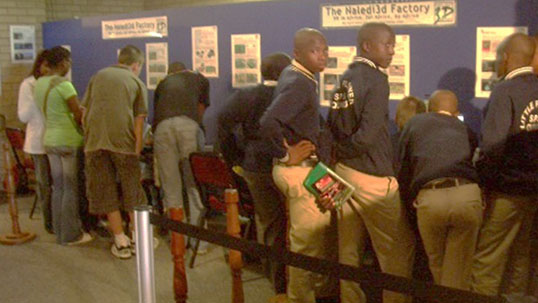




A time spent introducing VR to both industry and state organisations across South and Southern Africa, working through the ten CSIR Divisions. This was also a time of musing and reflection, looking at how could VR, impact on education, training and learning, and especially so in Africa. Delving into this was truly innovative at the time, with acknowledgement also being given to the inputs of Dr RS Day, then of the CSIR Meraka Institute.
https://www.engineeringnews.co.za/article/the-digital-factory-2000-01-28
 Paper presented “the potential for VR in Africa, and in particular, on learning and education”.
It was at this conference that we caught the attention of UNESCO (John Rose, CI Division. Paris); and was the start of a long-term relationship with UNESCO that continues to this day.
We opened our doors on 1st November 2000 and the second new SME company to join the new Innovation Hub, which was at the time starting up, based at CSIR Building 43.
Afternoon workshop – “Virtual Reality – An opportunity for education in Africa”.
Supported by UNESCO, this was the first time that we had an opportunity to put our ideas and vision forward to an audience in Africa. The response was inspirational. As the workshop finished, we were interviewed by CNN for the weekly CNN Africa in Focus slot.
In our first project with UNESCO, we addressed basic hygiene in the District of Nakaseke / Luwero, in Northern Uganda.
The project ran through the local multi- purpose community centre in the village of Nakaseke, which had electricity, but no running water. The VR content was later taken by the Centre to outlying communities, where there was neither water nor electricity…. And it was well received.
This work led to a significant drop in reported dysentery rates in the district and was still being used fifteen years later by the Nakaseke Centre.
This is a project that we are still immensely proud of, but also a project that shows the power of visual and interactive communication.
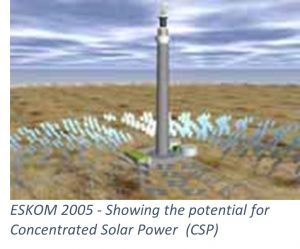
 Visualising new and innovative sustainable community power generation technologies – and also larger solar, wind turbines, concentrated solar power (all now a reality in SA) as well as hydro power generation (using disused mines).
We also visualised the visual impacts of using proposed wind and solar power generation on Robben Island as a replacement for imported diesel fuel.
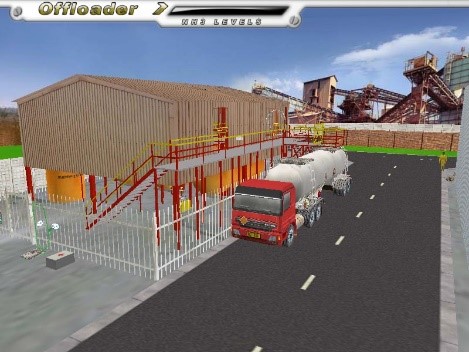
 Working with AngloGold Ashanti, we worked on several projects addressing safety related issuescontent – which led to saving lives. We showed many hazards, such as fall of ground, travel way vs non-travel way, mud rush, triangle of death, safe offloading of ammonia the impact of the various forms of energy on safety, for example.
It was while working on this programme that we came to understand the true value of SHOWING what can happen if you do something wrong or take shortcuts in a deep mine.
Showing someone how they could die does tend to lead to an immediate change in behaviour.
Another proud moment for us was the fact that after less than two years in operation, we were showcasing innovative VR content on three exhibition stands at the Ubuntu Village, a part of the prestigious Summit held in 2002 in Johannesburg. These were:
• City of Johannesburg – Moroka Dam rehabilitation
• ESKOM stand – sustainable energy technologies
• Hewlett Packard stand – showcasing our UNESCO basic hygiene simulation – with Virtual Nakaseke
Ubuntu Village was one of the venues established to host the 40 000 plus visitors to the Summit. Sited at Wanderers Stadium, Ubuntu Village included the erection of “Tensile 1” – the world’s biggest tent structure at the time.
Working with Dr Fay Chung (IICBA Director, past Minister of Education in Zimbabwe, Dr Fay Chung and a well-known champion of education and didactic principles during the Zimbabwe liberation struggle / second Chimurenga in the 1970’s).
Individual projects with Fay and IICBA focussed on addressing issues around HIV-AIDS, and on empowering educators in Ethiopia to better understand the issues around the disease, including stigma.
Follow-on projects looked at the connections between maths and science and HIV. This was a great opportunity to make STEM and HIV relevant to everyday life.
Despite having few IT resources in the classroom, educators had a better understanding of the underlying issues around HIV and the AIDS syndrome, and thus were better equipped to teach their young learners in class.
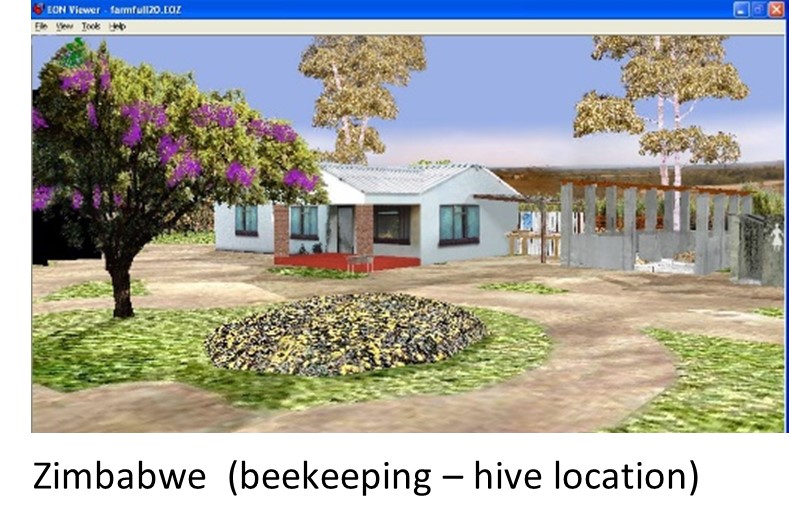
 Together with World Links Zimbabwe and WK Kellogg Foundation, we worked with farmers in 5 districts on agricultural skills development (Mutoko, Mandedza, Rio Tinto, Rio Mubira and Rusike) – starting with beekeeping, expanding into soil conversation, plough settings, pests, sorghum – and “growing” from there…
The most important part of our work is impact; and in this project, this was our best and most rewarding project at the time.
Because of the visual nature of VR, after the 2-day workshops with local farmers, the impact was immediate (the next day) as farmers effected a change in their farming practices.
Seeing is, it seems, is truly believing.
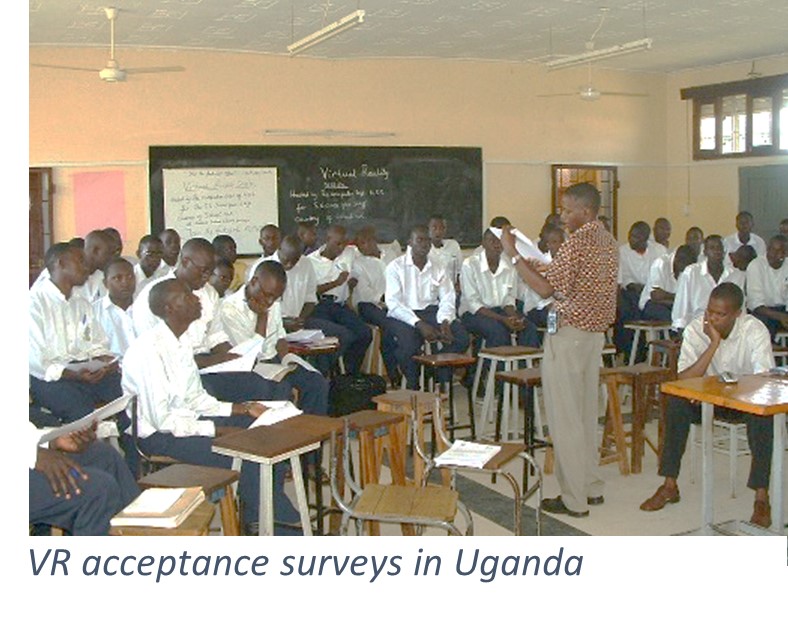
 Funded by UNESCO, this empirical study looked at the reaction to VR in schools (both educators and scholars), in Ugandan and South African schools. This research study is documented in a research report that can be downloaded from UNESCO’s library.
“Evaluation of Virtual Reality In Africa, An Educational Perspective”, UNESCO, Paris, 2004. (CI-2004/WS/1)
The study drew on VR acceptability and usability surveys in schools in South Africa (Mamelodi and Soshanguve) and Uganda (Buwama, Makerere College, Nakaseke, Ndejje, Saint Henry’s schools).
For the first time, the potential for VR in African schools and colleges was tested and proven. More so, because the learners only complaint was that there needs to be much more content, and over many more subject areas.
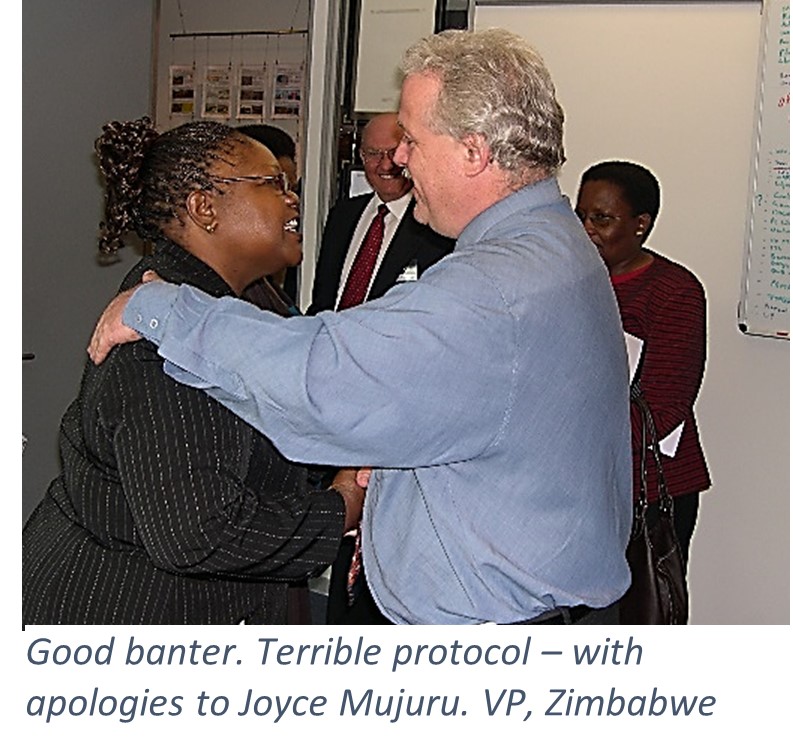 Hon. Joyce Mujuru Vice-President, Zimbabwe
HE Phumzile Mlambo-Ncguka Deputy-President SA
HE Luìsa Diogo Vice-President Mozambique
As part of their visit to The Innovation Hub, we had the pleasure of hosting three Southern African Vice Presidents in our office to present our work. A big thumbs up for Southern Africa as not only were we hosting three VP’s, but three female VP’s nogal. This was yet another proud moment on our journey.
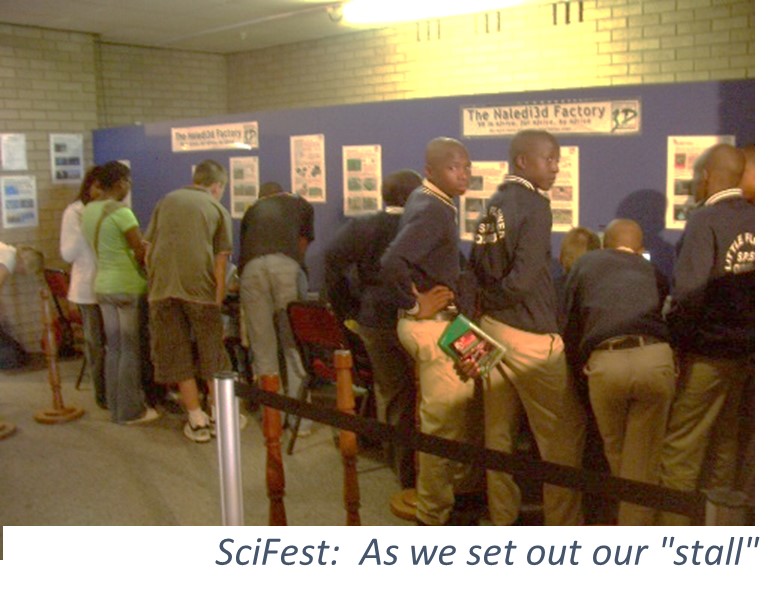 SciFest is South Africa’s biggest youth science event with tens of thousands of young people attending every year.
It was extremely rewarding to be able to have an opportunity to open so many young minds to what is possible…
We were invited by the Institute of Electrical and Electronics Engineers (IEEE) to write a paper on our VR work in Africa – a paper that is still referenced by researchers worldwide. We are also proud of this one…
“Using VR for Human Development in Africa”. IEEE Computer Graphics and Applications ( Volume: 28 , Issue: 3 , May-June 2008 Link to IEEE.org Computer Graphics digital library .
Registration of I3dlo’s (Interactive3d learning objects) as a learning concept, and as an international trademark, with help from SAFIPA (South African Finish Partnership SA).
The learning concept of the “learning object”. A Reusable Learning Object is the chameleon of eLearning and can be reused time and again in a variety of different eLearning activities, modules, and courses. Each has its own learning objective.
Our big breakthrough with i3dlo’s was in fact to also develop a process to localise VR content – not only to localise, but in a way that anyone can change the language, without having to use the base proprietary VR software – and only using a tool like WINZIP.
 Building on 15 years of VR experience, and the learning insights that we had gained, we created a “funky” style for short, fun, and engaging 3D animated videos. This medium and style is also be a powerful way to get important messaging across, as it is designed to capture the audience’s interest, and keep them engaged.
The base-premise was that if you can keep an audience engaged, whatever the medium used, then the messaging is not only easily internalised, but also easily memorised – and that is after all the end goal.
By using a video format, it also means that the messaging can be distributed far and wide, using devices from phones to TV and harnessing the reach of today’s social media.
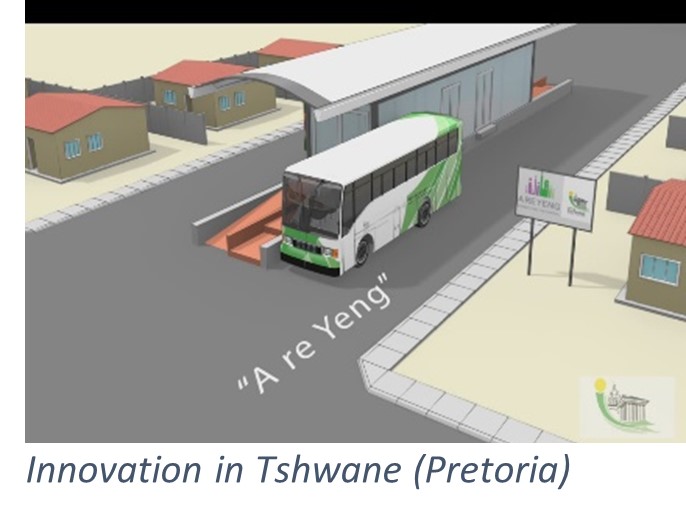
We’ve since created several stories, ranging from how a business works and the roles of shareholders, managers and workers; the role of innovation in a municipality; to explaining the SI measurement system for kids; explaining the importance of the Quality Infrastructure (QI) for SME owners across Africa; to the importance of accurate measurement (working with NMISA).
Our latest work, with UNESCO, is looking at the COVID-19 pandemic from the perspective of how do we safely return to work, how do address stigma, and looking at ways to get the messaging out in not only the minority languages across Africa, but also in sign language.
Asked by UNIDO to evaluate the impact of a diesel engine training App – “LKDF Interact” – used at the Volvo Selam Vocational Training College in Addis Ababa).
In the same way that both learners and educators in 2004 came out very strongly for VR in the classroom, so too with the technical students at the TVET College in Addis Ababa.
100% of the students, and lecturers wanted more content, and in a wider range of subject areas.
Once again, as in 2004, learners and students in Africa, irrespective of social backgrounds have spoken up for more VR content to support their curricula.
In late 2014, the City of Tshwane and EON Reality (a leading US VR Company) signed an “IDC Agreement” to establish the Tshwane Interactive Digital Centre, one in a global network of other IDC’s.
Naledi3d Factory was tasked in the Agreement as the local, experienced entity to establish, and to manage the Centre.
The Centre launched in April 2016 in Hatfield and was a first for Africa. It comprised a training centre (Virtual Reality Innovation Academy – VRIA) and that enrolled 50 young interns a year and offered training in the art of VR content development and entrepreneurial skills – a eleven-month programme. Around 85% of those that completed the programme found employment within weeks of completion.
The Development Studio created new VR content to address local needs. The 500m2 showroom showcased all VR technologies available at the time – from mobile to Cube and all points inbetween.
In mid-2019, the Centre was handed over to the City of Tshwane as a working Centre and the Centre was moved to TLMA (Tshwane Leadership and Management Centre) in Pretoria West.
We were invited by UNIDO to present at the 2017 UNIDO General Conference Plenary session in Vienna, and to also participate parallel UNIDO LKDF 4th Donor Conference.
Interview here
Together with UNIDO, we had previously worked on a project to address chainsaw operations and use, as part of a broader training programme in Kwa-Zulu Natal.
UNIDO asked us to showcase this work during the Plenary session, as a part of a presentation on the project